Izmir is the third most populous city in Turkey, after Istanbul and Ankara. It is on the Aegean coast of Anatolia, and is the capital of İzmir Province. As of 2024, İzmir Province has a total population of 4,493,242, while İzmir city has around 3.3 million inhabitants. It extends along the outlying waters of the Gulf of İzmir and inland to the north across the Gediz River Delta; to the east along an alluvial plain created by several small streams; and to slightly more rugged terrain in the south. İzmir’s climate is Mediterranean.
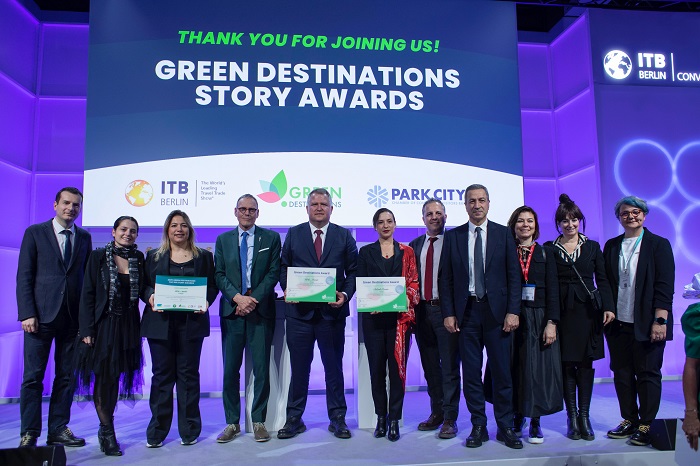
At the ITB Berlin 2025 conference, the Green Destinations award programme announced that İzmir (Türkiye) won the People’s Choice Award for its story “Unveiling Urla’s Wine Heritage: The Birth of the Urla Vineyard Route”.
In addition, two districts of the wider İzmir region — Urla and Selçuk — were awarded the Silver Level Certificate by Green Destinations for sustainable destination practices (waste management, energy/climate, heritage protection etc.).
This means that when you visit İzmir and its surroundings, you’ll find a region that is actively engaging in sustainable tourism
Green Destinations certification is based on the Green Destinations Standard (recognised by the GSTC): it requires the destination to demonstrate sustainable governance and management, measurable actions on the environment, energy, waste, transport and heritage, stakeholder involvement and improvement plans (independent audit and action plan).
“Silver” indicates a medium-high level of compliance verified by external auditors.
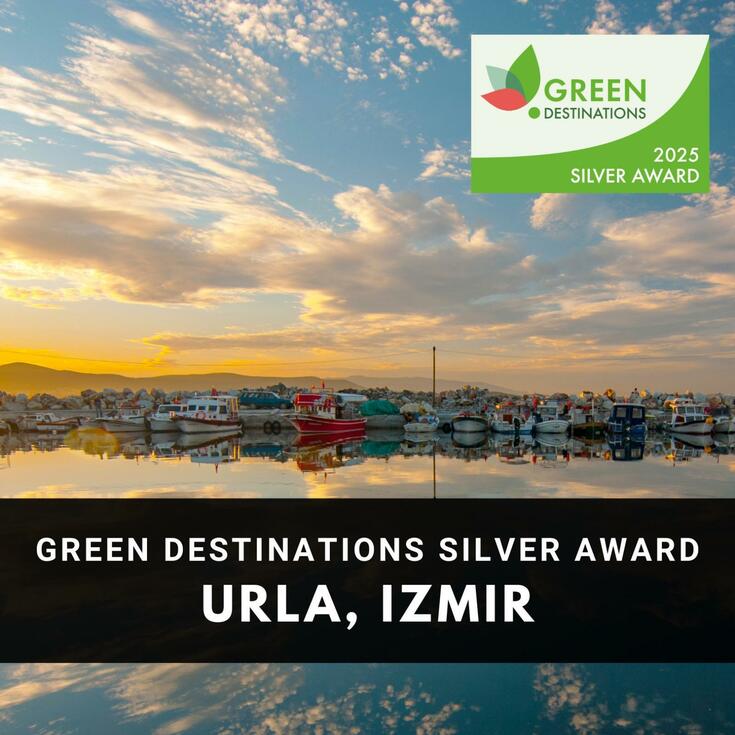
Urla
Urla is located on the Karaburun Peninsula, about 35 km west of İzmir, on the Aegean coast. It is one of the most renowned rural and wine-producing areas of western Türkiye.
According to the latest available data (2024), the estimated population is around 79,610 residents.
In recent years, demographic growth has been significant, reflecting the increasing interest in the area—likely due to its environmental quality, proximity to the sea and to İzmir, and its appeal as both a residential and tourist destination.
Urla is therefore not a small isolated village: it has a sizable and steadily growing population for a district.
Historical Overview
Urla (ancient Clazomenae) was one of the Ionian cities of ancient Greece.
It is known as the birthplace of the philosopher Anaxagoras.
The area has a long tradition of vine and olive cultivation, dating back more than 2,500 years.
During the Ottoman Empire, it served as an important agricultural and commercial hub.
Strengths
- Excellent local food: award-winning olive oils, Aegean cuisine based on wild herbs, fresh seafood.
- Sea and nature: quiet bays, uncrowded beaches, trekking and cycling routes.
- No heavy industry: according to studies, there are no major industrial plants in Urla—only small agricultural or artisanal businesses. This helps preserve a low-pollution environment and a relaxed atmosphere.
- Slow lifestyle, tourism and culture: a mix of tradition, history, gastronomy, local flavours and nature—ideal for those seeking a relaxed, high-quality lifestyle with rich cultural and recreational opportunities.
Who Urla Is Ideal For
Urla appears to be an excellent choice for:
- those who love the sea, nature, Mediterranean environments and a peaceful, high-quality lifestyle;
- those who value local food, agriculture, traditional flavours and sustainability;
- those seeking a balance between rural / semi-urban life and modern convenience thanks to its proximity to İzmir;
- those willing to live in a growing area, accepting slightly higher property prices and a reliance on cars.
The same elements that define quality of life for residents are at the core of the strategies that contributed to Urla’s Silver Certification.
🟦 Urla Vineyard Route (Reviving the Local Wine Culture)
A flagship project for Urla’s territorial sustainability. It restored the area’s viticultural heritage by creating a sustainable wine tourism route that connects producers, restaurants and farm stays.
It promotes low-impact agricultural practices, protection of the rural landscape and economic diversification.
Low-impact viticulture practices: integrated pest management, reduced use of pesticides, soil management techniques that support biodiversity, and organic or G.A.P. approaches. This is the core of Urla’s rural offer (Urla Vineyard Route). Several producers explicitly declare organic methods or “good agricultural practices” in their records and promotional materials.
Recovery and valorisation of local varieties and agricultural heritage: local projects aim to revitalise native grape varieties and traditional cultivars (clone selection, targeted replanting) to restore territorial identity and increase environmental resilience (genetic diversity = lower vulnerability). Wineries such as Urla Şarapçılık explicitly refer to efforts in “re-diversification” and selection of local varieties.
Multifunctional and regenerative agriculture: many farms combine agriculture with tourism activities—agritourism, educational farming, farm-to-table sales, small processing workshops (olive oil, preserves, wine)—to diversify income and reduce land pressure. Academic studies on Türkiye highlight the adoption of “multifunctionality” as a rural strategy.
🟦 Public–Private Cooperation and Capacity Building
The Municipality of Urla and the İzmir Metropolitan Municipality have established permanent coordination platforms involving businesses, farms, universities and tourism organisations.
Technical training and sustainable marketing programmes have been implemented to improve the quality of tourism services and strengthen the competitiveness of local enterprises.
This multi-stakeholder approach ensures shared management and transparent governance, fully aligned with the Green Destinations Standard indicators.
🟦 Local Economic Development and Sustainable Experiential Tourism
- Focus on enhancing local products (wine, olive oil, aromatic herbs, honey) as drivers of development.
- Creation of experiential tourism activities: workshops, seasonal harvesting, tastings, rural itineraries.
- Incentives for circular economy practices (bottle reuse, composting of winery waste, short supply chains).
- Strong involvement of women and young people in new micro-enterprises linked to sustainable tourism.
🟦 Protection of Rural and Landscape Heritage
Strategies aim to preserve the rural mosaic (vineyards, olive groves, villages) and manage tourism flows to prevent landscape degradation and the loss of traditional agricultural practices.
As part of the process, a Destination Management Unit was established within the İzmir Tourism Office to coordinate public and private stakeholders (municipalities, enterprises, operators), implement sustainable practices and monitor tourism impacts.
Landscape protection and sensitive planning:
Municipal and private projects include landscaping interventions that respect existing trees, dry-stone walls and traditional layouts (paths, trails, restoration of green areas).
The Iskele/Urla area also receives special attention for the preservation of archaeological heritage and cultural landscape, influencing land-use planning.
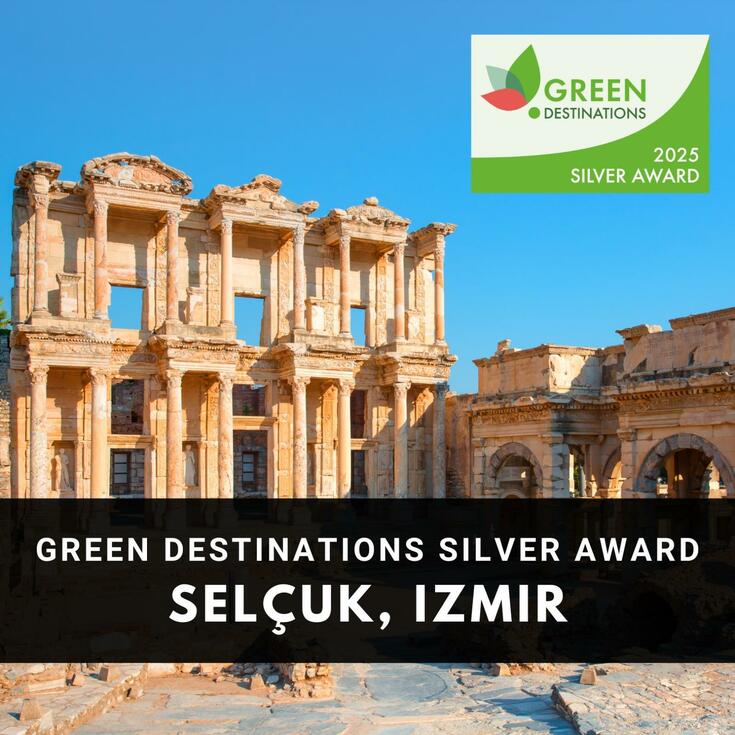
Selçuk
Selçuk is a district in the province of İzmir, located in Türkiye’s Aegean region, close to the Aegean coast and just 2 km from the ancient city of Ephesus, one of the most visited archaeological sites in the world.
It is efficiently connected to the city of İzmir (approx. 60 km) via railway and major roads, and lies near coastal destinations such as Kuşadası.
The territory alternates between urbanised areas, rural zones with vineyards, olive groves and mixed agriculture, and natural landscapes linked to the Küçük Menderes River valley.
According to official data from the Address Based Population Registration System (ADNKS / TÜİK) and local surveys updated to 2024, the population of the Selçuk district is approximately 38,600–38,700 inhabitants (the most cited figure for 2024 is 38,688).
It is therefore a medium-small centre, with strong seasonal peaks driven by tourism.
Historical Background
The history of Selçuk spans thousands of years and multiple civilisations: from prehistoric settlements and Greek colonies to Imperial Rome; from Christianisation and Late Antiquity to the arrival of the Turks, and finally the modern era marked by archaeology and cultural tourism.
In this sense, Selçuk — thanks to Ephesus and Ayasuluk Hill — is one of the most layered and historically rich contexts in western Anatolia.
The History of Selçuk – 10 Key Points
- Prehistoric settlements: the area has been inhabited since the Neolithic and Bronze Ages.
- Hittite identification: the ancient name Apasas (or similar) may refer to the earliest form of Ephesus.
- Greek foundation: it became one of the main Ionian cities and an important Mediterranean port.
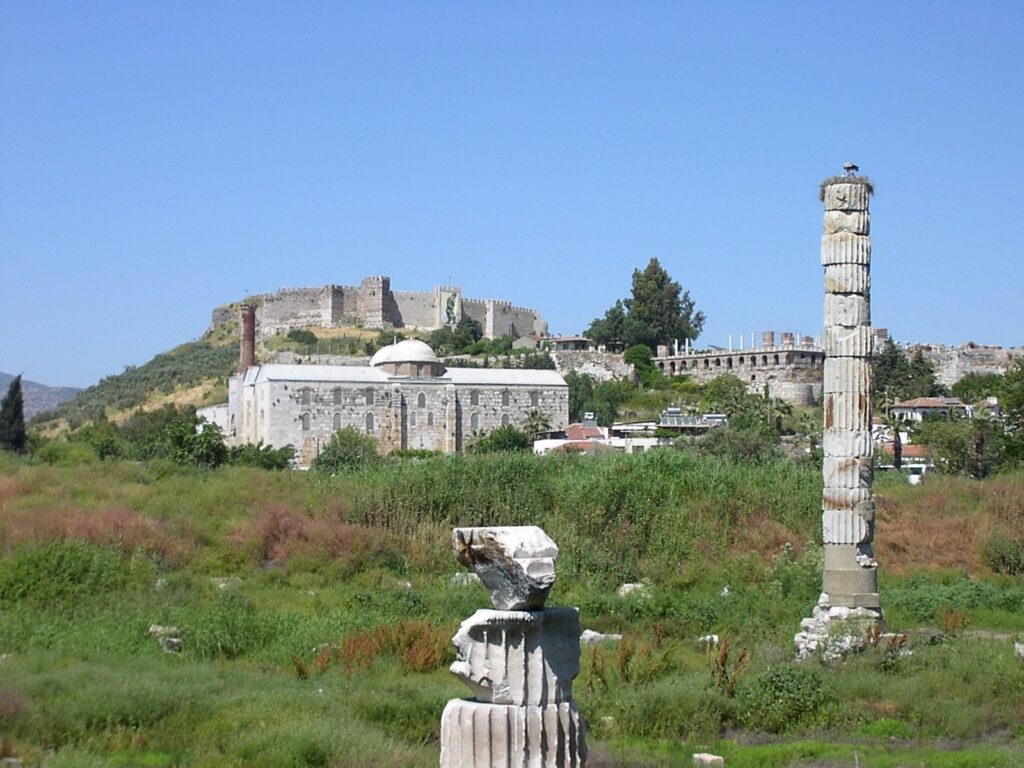
- Temple of Artemis: in the 6th century BC the city moved next to the sanctuary, one of the Seven Wonders of the Ancient World.
- Hellenistic re-foundation (c. 300 BC): Ephesus was expanded and monumentalised by a general of Alexander the Great.
- Roman golden age: capital of the Province of Asia, with up to 250,000 inhabitants; the Library of Celsus and the Great Theatre were built.
- Christian centre: from the early centuries it became a major religious site, with the tomb of St John and the proximity of the House of the Virgin Mary.
- Post-Roman decline: the port’s silting caused economic crisis and led to the settlement moving to Ayasuluk Hill.
- Turkish and Ottoman period: Ayasuluk became a strategic centre with its fortress and the Isa Bey Mosque; the town remained rural but active.
- Modern revival: from the 19th century onwards, archaeological excavations brought Ephesus back to light and transformed Selçuk into an international cultural and tourism hub.
Strengths
Rich historical and cultural heritage
The proximity to Ephesus, the Temple of Artemis, the Basilica of St John and the House of the Virgin Mary makes Selçuk one of Türkiye’s most significant cultural destinations, where history, religion and anthropology coexist in a unique way.
Balanced quality of life
With a population of around 38,600, Selçuk offers a slower pace of life compared with larger cities, without sacrificing essential services. Healthcare facilities, schools and key local services cover everyday needs, while İzmir provides access to more advanced services.
Strong agricultural identity and access to local products
The local economy combines tourism with high-quality agriculture (grape, olive, fig, citrus).
Local markets offer fresh products at generally affordable prices, supporting a healthy and accessible lifestyle.
Sustainability-focused initiatives
Recent years have seen the development of agritourism and environmental education projects, including demonstration farming villages and rural valorisation routes. These initiatives aim to protect the landscape and promote sustainable agricultural practices.
Strategic location and mobility
Selçuk is well connected by train, bus and major roads.
Its proximity to İzmir Adnan Menderes Airport makes it attractive and accessible for remote workers and those with international connections.
Welcoming community and “slow living”
There is a strong sense of community, with cultural festivals, local events and a more relaxed daily life compared with large urban centres.
The Mediterranean climate and compact urban fabric support a calm, enjoyable lifestyle.
Living in Selçuk
Ideal for:
- Tourism, culture and hospitality professionals: excellent for those working in heritage, hospitality or cultural experiences.
- People seeking balance between nature, history and services: perfect for those wanting tranquillity without isolation.
- Remote workers: lower costs than major European cities and easy access to İzmir.
- Families or couples looking for a slower lifestyle: good local services, safe environment, strong community.
- Agriculture or food-and-wine enthusiasts: ideal territory for small agricultural projects, agritourism or local product initiatives.
Key Elements Behind the Silver Certification
🟦 Ephesus Field Life Village
A sustainable agriculture, educational and agri-tourism project: an area (e.g., ~5,000 m², according to official information) dedicated to traditional farming practices, environmental education, workshops and experiences connecting rural communities with visitors.
🟦 Sustainable management of the Ephesus area and heritage protection
As the district including the UNESCO site of Ephesus, Selçuk has implemented measures to balance high visitor numbers with heritage protection, visitor management and the development of alternative routes (rural villages, cultural experiences) to help distribute tourist flows.
🟦 Support for local agriculture and traditional supply chains
Valorisation of local products (vine, olive, figs) and integration of resilient agricultural practices, along with measures to counter youth outmigration by creating local opportunities linked to sustainable tourism.
Examples of Local Products and Practices
Olive (EVOO and derivatives)
The Selçuk area and nearby valleys are part of the Aegean olive-growing tradition, with many farms using:
- manual harvesting
- cold pressing
- preservation of centuries-old olive groves as cultural heritage
The local “Zeytin Yolu” (Olive Route) promotes tourism itineraries, guided visits and educational tastings.
Figs (dried figs of the Küçük Menderes valley)
Selçuk is part of the high-quality fig production area (Mevlana figs).
Local cooperatives support artisanal processing and natural drying.
Pilot projects have tested solar-powered drying systems to cut energy use and improve hygiene standards.
Resilient Agriculture and Climate Adaptation
Low-water agriculture
Expansion of drip irrigation, especially for vineyards and orchards.
Pilot projects using IoT soil humidity sensors (UmbriaTech in partnership with Turkish companies).
Regenerative agriculture
Increasingly adopted techniques include:
- cover cropping
- compost from agricultural waste
- reduced tillage
- planting of native hedgerows and trees for functional biodiversity
Rural landscape restoration
Projects across the Aegean valley promote:
- restoration of historical terraces
- reintroduction of drought-resistant local varieties
- conservation of dry-stone walls and ancient rural structures, often linked to cultural tourism routes such as the Cultural Heritage Trail.
Economic Opportunities and Youth Retention
Micro-enterprises linked to sustainable tourism
Growth of small businesses such as:
- artisanal jam and preserve producers
- natural cosmetics based on olive products
- rural guesthouses collaborating with vineyards and agritourism farms
- tasting tours and cooking classes run by young entrepreneurs
Agricultural incubators and university programmes
Ege University and İzmir Katip Çelebi University offer:
- training in agri-food marketing
- courses on innovation in Mediterranean agriculture
- Erasmus+ projects on climate resilience in farming systems
Mini-incubators support:
- digital agriculture start-ups
- sustainable packaging systems
- short-supply-chain distribution networks
Youth cooperatives and community models
Examples in nearby rural areas include:
- cooperatives such as Tire Süt Kooperatifi, whose model has been replicated in other sectors
- young farmers in Selçuk launching biodynamic production and direct local markets with support from the agricultural district.
Concrete Examples of Recent Projects
(non-exhaustive, but representative of current directions)
- Urla Agro-Tourism Cluster – network connecting wineries, restaurants, agronomists and nature guides to create integrated rural tourism packages.
- Ephesus–Selçuk Rural Heritage Path – cultural route linking vineyards, historic hills and agricultural hamlets.
- İzmir Metropolitan Municipality – Sustainable Agriculture Programme (Sürdürülebilir Tarım Programı)
Supporting drought-resistant crops, quality improvement of local products, short supply chains and farmers’ markets. - Women’s Agricultural Cooperatives (Kadın Kooperatifleri)
Initiatives involving women and youth in:- fig drying
- olive oil and natural soap production
- processing of aromatic herbs
Community Engagement and Training
Educational programmes for operators, schools and awareness campaigns for residents and local businesses.
Integration with metropolitan policies
Activities are coordinated with İzmir Metropolitan Municipality (technical and strategic support), strengthening management capacity and compliance with standards.
Cross-cutting Measures and Procedural Requirements that Likely Made the Difference
(These are typical elements required and verified by Green Destinations and help explain why the assessment was positive.)
- A sustainability management system (reporting, indicators, and action plans for improvement).
- Independent audits assessing local practices and compliance with Green Destinations indicators.
- Measurable actions on environment (waste reduction, habitat protection), culture (heritage conservation), economy (benefits for local communities) and governance.
(The experiences of Urla and Selçuk show concrete examples in all these areas.)
Source of information
- Green Destinations official page — Awards Program / metodologia. greendestinations.org
- Visit İzmir Website— Urla Vineyard Route / Good Practice story. visitizmir.org
Extended Link https://www.greendestinations.org/wp-content/uploads/2025/09/Urla-2025-Top-100-Good-Practice-Story.pdf? - https://www.visitizmir.org/en/Content/345
- Green Destinations document about Selçuk — Ephesus Field Life Village (good practice story). greendestinations.org
- Local press releases and reports on the awarding of the Silver Certificate and official acknowledgements. https://en.wtcf.org.cn/20250313/4247b0b5-bd9f-d0db-f297-9df9ffecec2f.html
Sara
Would you like to subscribe to my newsletter? In English, I am using the LinkedIn newsletter. I want to use it because I can learn more about who has subscribed from the LinkedIn profile. Here is the link: https://www.linkedin.com/newsletters/7107445901593313280/
Would you like to join the community newsletter, too? Now you can! From April 2026, I will write in both Italian and English.
Sign up here: https://dashboard.mailerlite.com/forms/414805/95406504960591215/share
The Community newsletter is a private newsletter that brings to subscribers (many friends, colleagues, ex collaborators, new potential ones, clients and so on) topics and information such as:
news from my personal contacts (such as newsletters)
calls for proposals
industry events – even if I don’t attend
research and tools I’ve found or tried.